
Find People Through Wake Forest Records
A useful search begins with the fact already known. A current name works well in the Wake County owner roll, the Register of Deeds index, North Carolina court cases, voter registration, and state business records. An address calls for the property roll and iMAPS first. An older address needs the deed chain, exact-year sources, and historic place names. A phone number or email may produce a broad identity lead, but an official record is better for checking the name, date, role, and jurisdiction.
Keep each source in its lane. A parcel identifies the owner of record, not every occupant. A court result identifies a party and case role, not the merits of a claim. A voter entry shows registration geography and participation, never a ballot choice. Dates matter because people move and public files change.
- Write down the full name, likely date range, and any known address or relative.
- Confirm whether the address belongs to Wake County or Franklin County before choosing a portal.
- Search the property roll, deed index, and court portal with spelling and name variants.
- Compare at least two records by date, address, role, or parcel reference.
- Ask the custodian, library, courthouse, or archive when the online record ends.
Note: Preserve the exact source, retrieval date, and party role so that two similar Wake Forest names do not become one person by mistake.
Wake Forest Crosses Records Lines
Most Wake Forest people records route through Wake County, whose county seat is Raleigh. Yet the town and its extraterritorial planning jurisdiction, or ETJ, extend into Franklin County. A Wake Forest mailing address may also fall outside town limits. Postal city, municipal boundary, planning area, and county are not the same thing.
This geography changes where a search goes. Use Wake County iMAPS to test an address, parcel, ownership link, and jurisdiction. If the parcel lies across the northern county line, switch to Franklin County GIS and its Register of Deeds instead of treating an empty Wake County result as proof that no record exists.
The official Wake County iMAPS view shows why this check belongs near the start of a Wake Forest record search.
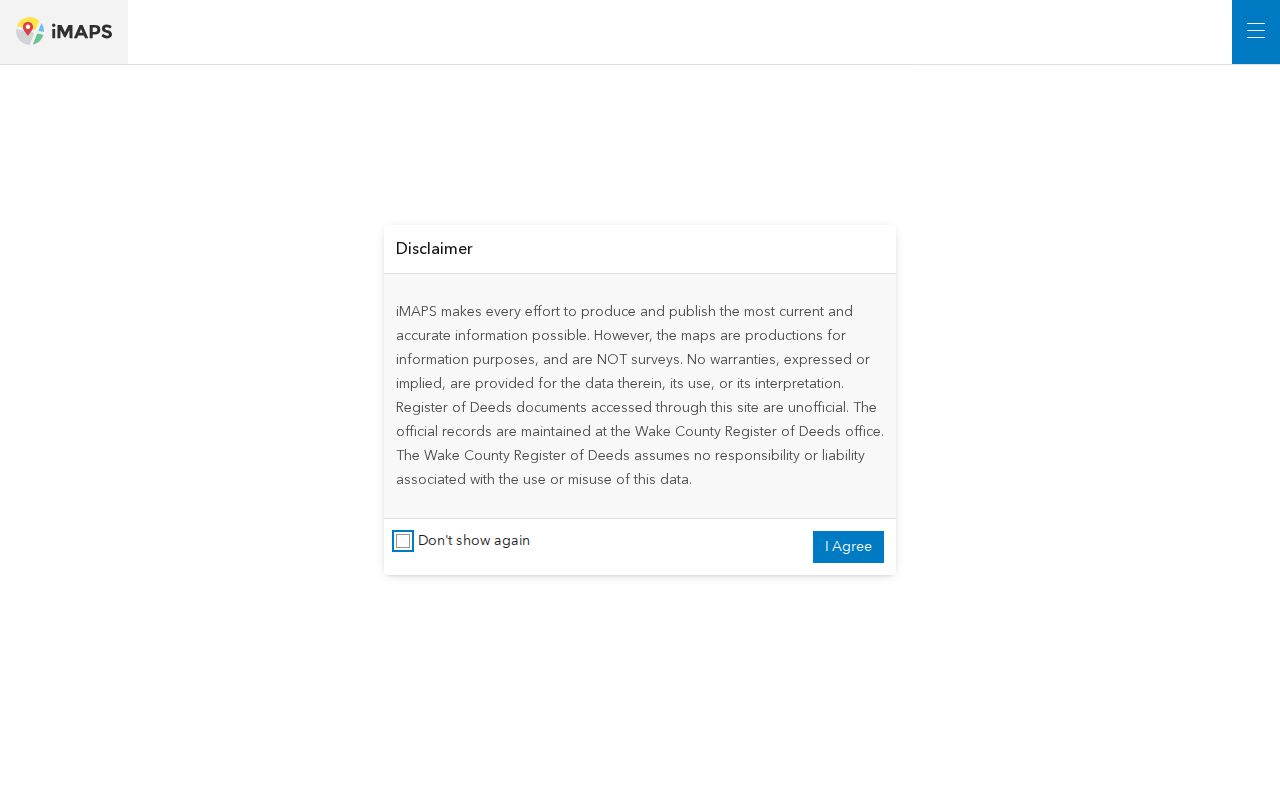
Use the map to establish custody, then preserve the parcel’s PIN or real-estate identification number for the next search.
Boundary key: “Wake Forest” on an envelope does not decide which county keeps a deed, tax record, or local vital certificate.
Wake Forest People Records Offices
Wake Forest has no single office holding every person record. The Town Clerk keeps municipal minutes, ordinances, board material, contracts, petitions, and correspondence. Wake County offices hold most deeds, tax ownership, local certificates, and court files. The North Carolina Judicial Branch runs the courts, while state agencies maintain voter, correctional, business, license, and statewide vital records. Each custodian applies its own access and copy rules.
Wake County Register of Deeds
Wake County Justice Center
300 S. Salisbury St., Suite 1700
Raleigh, NC
919-856-5460
Wake County Court Clerk
District, Superior, estate, and special proceedings
Raleigh, NC
Use the official location page
Town Hall is open Monday through Friday from 8 a.m. to 4 p.m. A narrow municipal request should name the board or department, date range, person, address, or project and state whether electronic or paper delivery is preferred.
Search Wake Forest Property Owners
The Wake County property roll is often the fastest bridge from a surname to an address. Wake Real Estate Search accepts owner, property address, REID, or PIN. An owner result can show the owner and co-owner lines, mailing address, physical property address, legal description, assessed value, deed book and page, sales, building facts, tax district, and map links.
The owner’s mailing address is separate from the situs address, meaning the physical site. That difference can help a Wake Forest people search, but it does not prove where anyone lives. Trusts, businesses, heirs, and care-of lines also need exact transcription. The Deeds and Sales tabs show transactions, not a full list of occupants.
| Search mode | Required entry | Useful format note |
|---|---|---|
| Individual owner | Last name | Up to 15 characters; first and middle names can narrow results |
| Business owner | Business name | Up to 30 characters |
| Street address | Street name | Omit a suffix such as Road or Drive; street number is optional |
| REID | Numeric identifier | Up to seven digits; the system pads the value on the left |
| PIN browse | Map details | Uses map, scale, block, and lot fields |
The captured Wake Real Estate Search interface shows the distinct owner, address, ID, and PIN routes available to Wake Forest searchers.
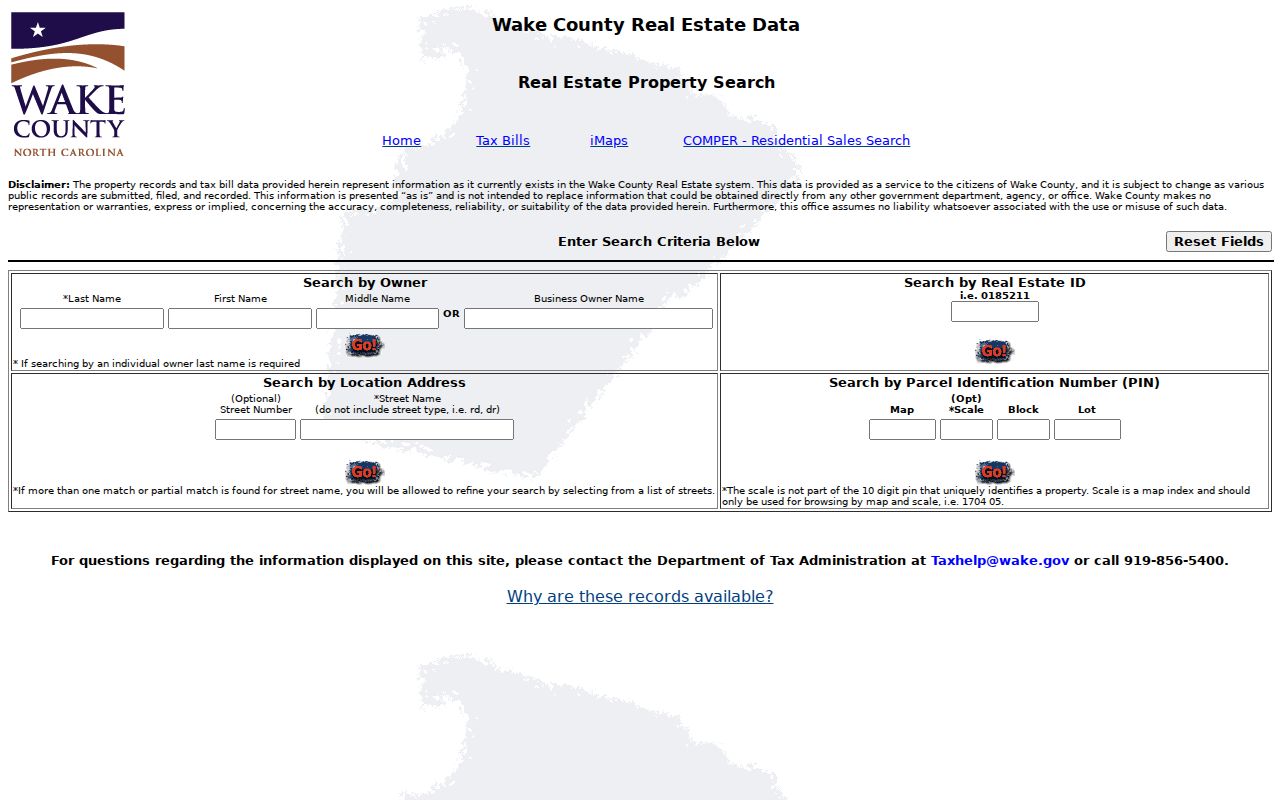
Record the REID or PIN from a strong result because it links the tax entry to mapping and deed references even when a street label changes.
Follow Wake Forest Names Through Deeds
Deeds extend an owner search across time. In the Wake County Register of Deeds index, a grantor is the party giving or transferring an interest. A grantee receives it. Search both roles, allow for initials and former names, widen the date range, and inspect the actual image after finding a likely index row. The county warns that its index works like a library catalog. It locates an instrument but is not the legal instrument itself.
The Consolidated Real Property Index states that recorded document images run from July 1785 forward. An image may add the exact recording time, execution date, party capacity, mailing address, preparer, return address, parcel identifier, legal description, and earlier title reference. Certified copies and material outside web coverage still come from the recorder.
The Wake County deed index shows the official entry point used to move from a name to book, page, document, and image.
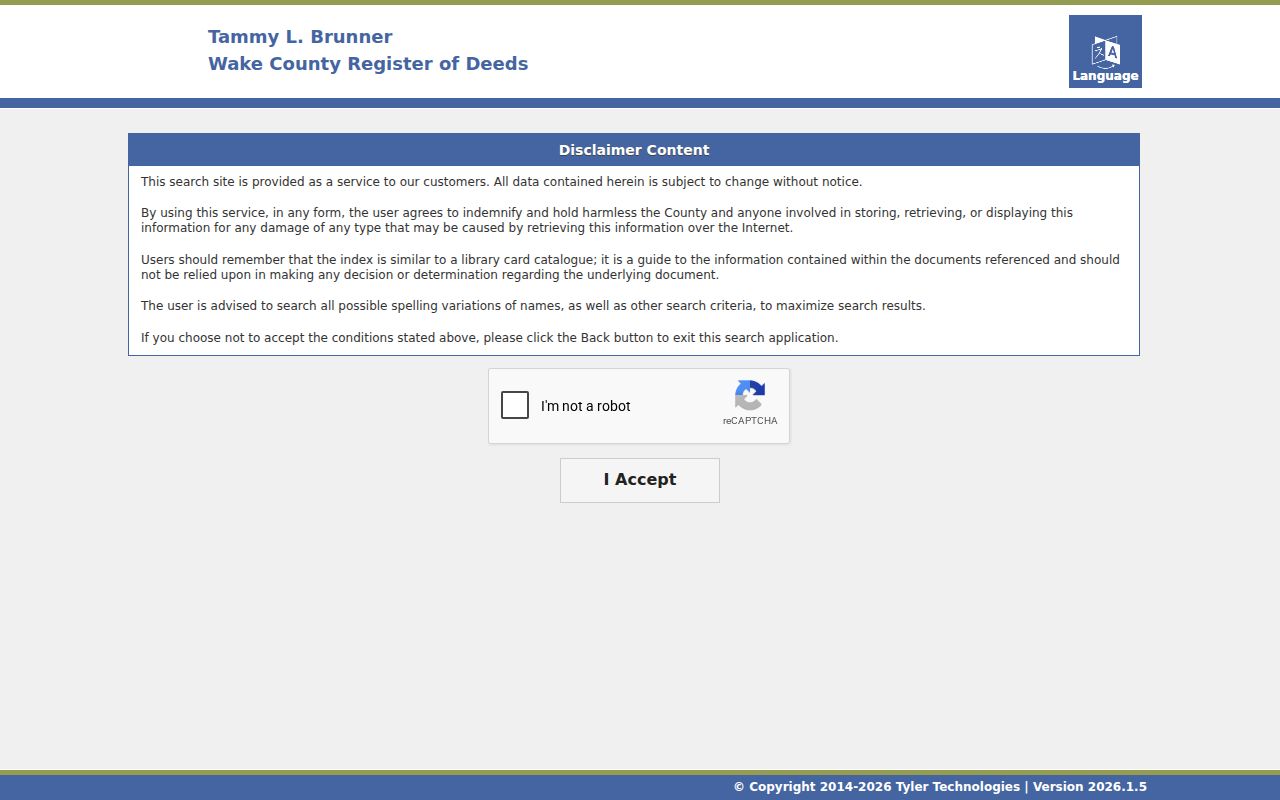
Read the scanned deed before drawing a conclusion, especially when a trust, estate, business, or similarly named person appears.
- Index
- A locator that points to a recorded instrument or court file.
- Grantor
- The party transferring an interest in a recorded document.
- Grantee
- The party receiving the interest.
- Book and page
- The recorder’s reference used to retrieve the underlying instrument.
Note: Search all plausible spellings because the official county application warns that a single spelling may miss a relevant Wake Forest instrument.
Find Wake Forest Court Records
Wake Forest has no municipal court. The Wake County District and Superior Courts handle local civil, criminal, family, estate, and special-proceeding files through North Carolina’s state system. The statewide eCourts Portal begins with a party name or case number. Advanced fields can narrow the court location, date of birth, related party, case type, status, and filing dates.
A docket is the running list of filings and events in a case. A public result may show the case number, caption, court, filed date, status, party roles, counsel, hearings, public disposition, and a document register. Sealed, expunged, juvenile, and adoption matters are excluded or restricted. Some family cases expose only a public shell.
| Wake Forest court trail | What it covers | Best access |
|---|---|---|
| Wake County District Court | Most misdemeanors, infractions, small claims, domestic matters, and lower-value civil cases | eCourts, courthouse terminal, or Clerk |
| Wake County Superior Court | Felonies and larger civil cases | eCourts, courthouse terminal, or Clerk |
| Clerk estates and proceedings | Probate, estates, and nonconfidential special proceedings | Portal discovery and Clerk file |
| Eastern District of North Carolina | Federal and bankruptcy matters | PACER or the federal clerk |
Courthouse terminals and Clerk staff are the fallback when documents are not viewable online. Inspection is free, and North Carolina court copies are listed at $0.25 per page, with possible charges for extraordinary service. A party hit is not the same as a finding against that person.
Trace Wake Forest Vital Records
For an event in Wake County, the Register of Deeds supplies county birth, death, and marriage certificates. North Carolina Vital Records handles statewide certificates, corrections, and divorce certificates. The divorce decree and case file instead belong to the Clerk of Superior Court. Older marriages route to the county that issued the license.
North Carolina does not use a simple rule that births open after one century and deaths after half a century. Under G.S. 130A-93, eligibility turns on the copy type and the requester’s relationship or authority. Wake County’s form lists the subject, current spouse, specified close relatives, and properly documented agents or legal representatives among its certified-copy routes. Uncertified access differs, while adoption information remains separately sealed.
Wake County charges $10 for each certified birth, death, or marriage certificate on its current form and requires a government photo ID copy. The state charges $24 for a three-year search and first certificate, then $15 for an added copy of that same certificate. Archives, church sources, newspapers, cemetery records, and exact-year collections can supply historical evidence without turning a lead into certified proof.
Note: Ask for a county certificate when the Wake County event is known, but use state Vital Records when the event county is uncertain.
Check Wake Forest Voter Records
The official NCSBE Voter Search is free and needs no account. First and last name are required. A middle initial and birth year can narrow common names, while county and status filters help separate results. Because the lookup has no city field, choose Wake County first and verify Wake Forest through the returned residence, municipality, precinct, and districts.
A result may show public registration status, registration date, party, birth year, polling place, jurisdictions, sample-ballot information, and participation history. It never reveals a candidate choice. Full birth date, Social Security and driver-license numbers, submitted email, ID material, and copied signatures are confidential under state law. Protected voters may also have a residence address withheld.
Voter data deserves its own field-by-field treatment. The Wake Forest voter registration search covers status codes, weekly files, participation history, protected records, and the Wake County Board of Elections fallback without turning a registration entry into a general identity dossier.
Search Old Wake Forest Place Names
The Town’s Wake Forest history creates a search quirk that modern address tools cannot solve alone. North Main Street was once Faculty Avenue. Forestville had its own identity before joining Wake Forest in 1988. The mill village entered town in 1977. A name tied to the former college community may appear in catalogs and account books, while a Forestville resident may be indexed under the older place name.
Build a small historical query matrix. Pair each spelling of the person’s name with Wake Forest, Forestville, Faculty Avenue, North Main, the college, and the likely year. Then compare the Town’s addressing and street-naming record with a deed, tax record, directory, yearbook, estate file, cemetery entry, or newspaper. Legal descriptions and book-page references can stay stable when a street name or boundary does not.
Wait Hall burned in 1933, but that campus fire is not evidence that Wake County deed or court series were destroyed. Digital coverage also varies by collection. The Town’s historic-district material, the Wake Forest Historical Museum’s collections, and the State Archives remain important when an online name search stops.
Reconnect Through Wake Forest Directories
Exact-year sources are stronger than a broad directory claim. Olivia Raney Local History Library has confirmed Wake Forest College yearbooks for selected years from 1912 through 1976, with gaps. These are discrete holdings, not one continuous run. The Wake Forest Historical Museum adds photographs, correspondence, community records, DuBois School material, and early college sources.
For a former classmate, begin with the school and year. Check the exact yearbook, then compare a full name with later newspapers, marriage or estate records, cemetery evidence, or a property trail. Ask library staff which Polk or Hill city directories include Forestville or Wake Forest, whether a criss-cross address section exists, and which phone books or obituary aids are held. No exact continuous Wake Forest reverse-directory run was verified.
Modern local rosters are narrower. Town departments publish browsable staff cards rather than one master staff search. Wake Forest High offers keyword, first-name, and last-name fields. The broader set of Wake Forest local directories explains what each official roster lists and where its limits begin.
Note: “Consult staff” in a catalog is an access instruction, so request the call number, container, restrictions, and reproduction terms.
Separate Wake Forest Custody Searches
Local detention, state correctional custody, federal incarceration, and statutory registration are different systems. Wake County Sheriff handles county detention. The North Carolina Department of Adult Correction covers state custody and supervision. Federal Bureau of Prisons online coverage starts in 1982, while older federal inmate research routes to the National Archives. The SBI registry has its own identity and geographic searches.
NC Offender Public Information accepts status, first and last name, a “Sounds Like” choice, offender number, sex, race, birth date, and age range. Use the system that matches the kind of custody or record instead of expecting one search to cover every arrest or case.
The captured state offender search shows the fields used to narrow a Wake Forest name in the correctional system.
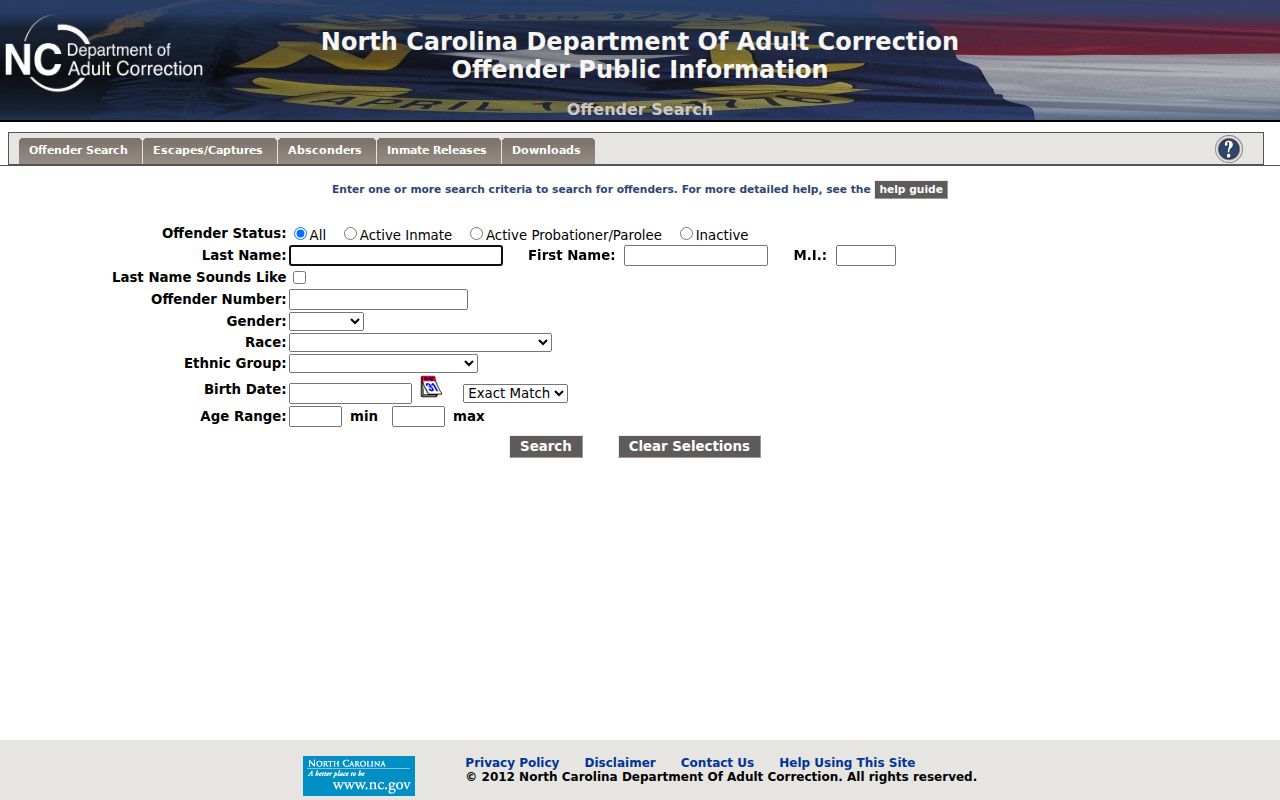
Date every result because custody and supervision status change. A charge is not a conviction, and a name match should be checked against the official photo, birth details, and identifier where available. Releasable local incident information follows the Wake Forest Police records route instead of the state correctional search.
Verify Wake Forest Business Names
A trade name can hide the legal entity behind a Wake Forest address. Search the North Carolina Secretary of State business index for the entity status, registered agent, principal or registered office, and filing history. Then check an assumed-name certificate through the Register of Deeds and use the relevant state licensing board when the work is regulated. Each source describes a role. A registered agent is not automatically an owner.
North Carolina’s official license systems cover fields such as medicine, nursing, law, contracting, real estate, cosmetology, education, and ABC permits. Matching an entity name, agent, license status, and local permit address can help verify a seller or avoid a scam. Wake Forest did not expose a general city business-license person index, so do not infer that a missing town result means a business has no state or county record.
Unclaimed property offers another lawful name-and-location lead. NC Cash indicates that the State Treasurer holds property associated with a name. It is not proof of a current home address.
The official NC Cash interface lets a Wake Forest searcher check the state source directly instead of trusting an unsolicited fee demand.
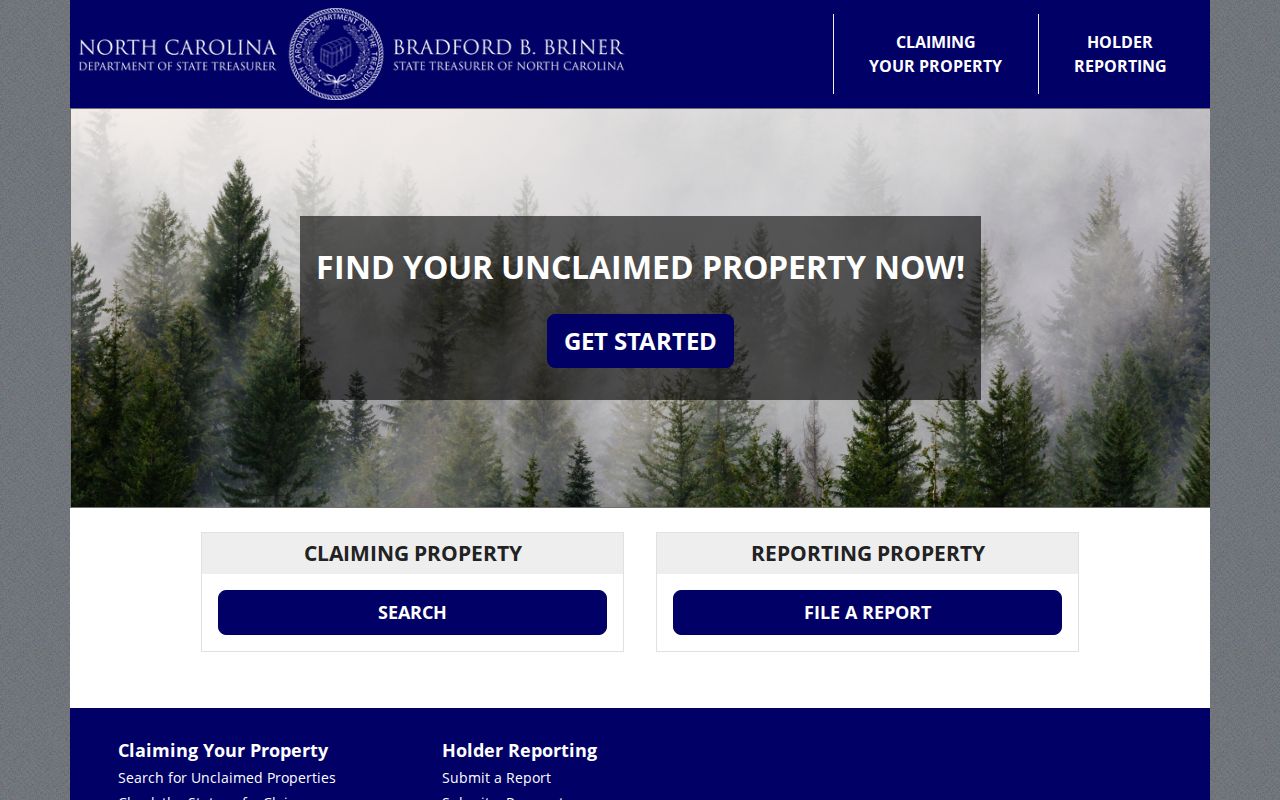
Verify a claimed match through the Treasurer’s process, and never pay a caller merely for access to the free state search.
Continue a Wake Forest Offline Search
Online indexes are discovery tools. When a search fails, contact the office that made or received the record. For a deed, use initials, former names, trust names, broader dates, and a book-page reference before asking the Register of Deeds for help or a certified copy. For a court case, bring the party variants, year, case number, and needed filing to the Clerk or courthouse terminal.
Municipal files follow a different path. Search agendas, minutes, ordinances, department rosters, and project pages first. If the item is absent, send a focused request to the Wake Forest Town Clerk with the department, names, address or project, date range, and desired format. North Carolina Chapter 132 allows any person to request records and does not require a purpose. Access must be provided as promptly as possible, but the law sets no fixed number of response days.
- Current address
- Start with GIS and the property roll; ask Tax Administration or the Franklin County counterpart when the portal stops.
- Owner name
- Use property and deed indexes first, then ask the Register of Deeds copy desk for the instrument.
- Court party
- Search eCourts, followed by the Wake County Clerk and a public terminal for the actual file.
- Historic resident
- Check yearbooks, catalogs, and archives before asking Olivia Raney, the Museum, or State Archives staff.
- Town action
- Review minutes and department pages, then submit a focused Town Clerk records request.
Older county court, estate, land, marriage, tax, election, school, and will series may sit at the State Archives. Search the State Archives catalog by office and record series as well as surname, then ask whether the item is original, microfilm, or digital.
Keep Wake Forest Searches Lawful
Use only the least personal data needed to answer a lawful question. Record the source and date, avoid copying protected identifiers, and delete working notes when they are no longer useful. Public availability does not permit stalking, threats, repeated unwanted monitoring, or harassment. North Carolina laws address stalking and specified electronic threats and tracking.
Commercial compiled searches may merge people, carry stale addresses, or omit the record’s role and date. Official sources are usually free to search and identify the custodian. They may require a copy fee or restrict sensitive material. Commercial results can be a lead, but they are not certified proof.
| Source type | Best use | Main limit |
|---|---|---|
| Official index | Find the office record and exact reference | An index row may omit facts shown in the file |
| Official copy | Read the full public instrument or filing | Closed portions may be redacted |
| Certified copy | Obtain the custodian’s authenticated copy | Fees and eligibility can apply |
| Commercial compilation | Generate a lead for personal research | May be stale, merged, or unsupported |
Lawful-use limit: Never use a Wake Forest address, voter entry, court result, or directory listing to stalk, harass, threaten, or harm anyone.
North Carolina’s Address Confidentiality Program provides a substitute government-record address and mail forwarding for qualifying relocated survivors. It protects future records in defined ways, but it does not erase every old deed or bind each private database. Follow the proper recorder process when a public instrument contains a protected identifier.