
Browse Wake Forest People Directories
No single roster lists everyone in Wake Forest. The useful sources are role directories. Town pages identify public staff and officials. The school directory lists faculty and support roles. Property and deed indexes name owners and transaction parties. State voter, business, and license tools list people within their own public duties. Yearbooks, museum collections, and cemetery evidence carry names further back.
| Wake Forest Directory | People or Roles Listed | Official Keeper | How to Browse |
|---|---|---|---|
| Town department rosters | Current names, titles, work email, and office or cell phone | Town of Wake Forest | Free department-by-department browse |
| Wake Forest High directory | Faculty and staff with role classification and contact entry | WCPSS | Free keyword and name search |
| Wake Real Estate Search | Owners of record, mailing and situs addresses, parcels | Wake County Tax Administration | Free owner, address, REID, or PIN search |
| Register of Deeds indexes | Grantors, grantees, instrument roles, and dates | Wake County Register of Deeds | Free current app or historical CRPI |
| Public voter file | Registered and former voters with permitted public fields | NCSBE | Free weekly files and snapshots |
| Official business and license tools | Entities, agents, licensees, status, and public addresses | Secretary of State and state boards | Free official lookups |
| Yearbooks and local collections | Students, faculty, residents, groups, and local places | Olivia Raney and Wake Forest Historical Museum | Digital items, catalog, or staff-assisted access |
Begin with the person’s likely role and time period. A current teacher belongs in the school tool, while an old classmate may appear only in an exact-year book. A surname tied to land fits the tax roll or deed index. For access-law questions and copy procedures, use the Wake Forest public records resource rather than treating a directory row as a certified record.
Wake Forest Town Directory Roles
The Town staff landing page is a directory of departments, not one searchable employee database. Choose a department and scan its cards. Inspections, for example, publishes names, roles, email links, and extensions. The Finance roster inspected in July 2026 showed a director’s name, title, office telephone, government email, and Town Hall as the department location.
- Person
- Full staff name when the department publishes it
- Role
- Staff title and department context
- Contact
- Direct office number, extension, cell, department line, or government email when listed
- Office location
- Department office or Town Hall location where shown
The Town Inspections roster illustrates the card-style directory.
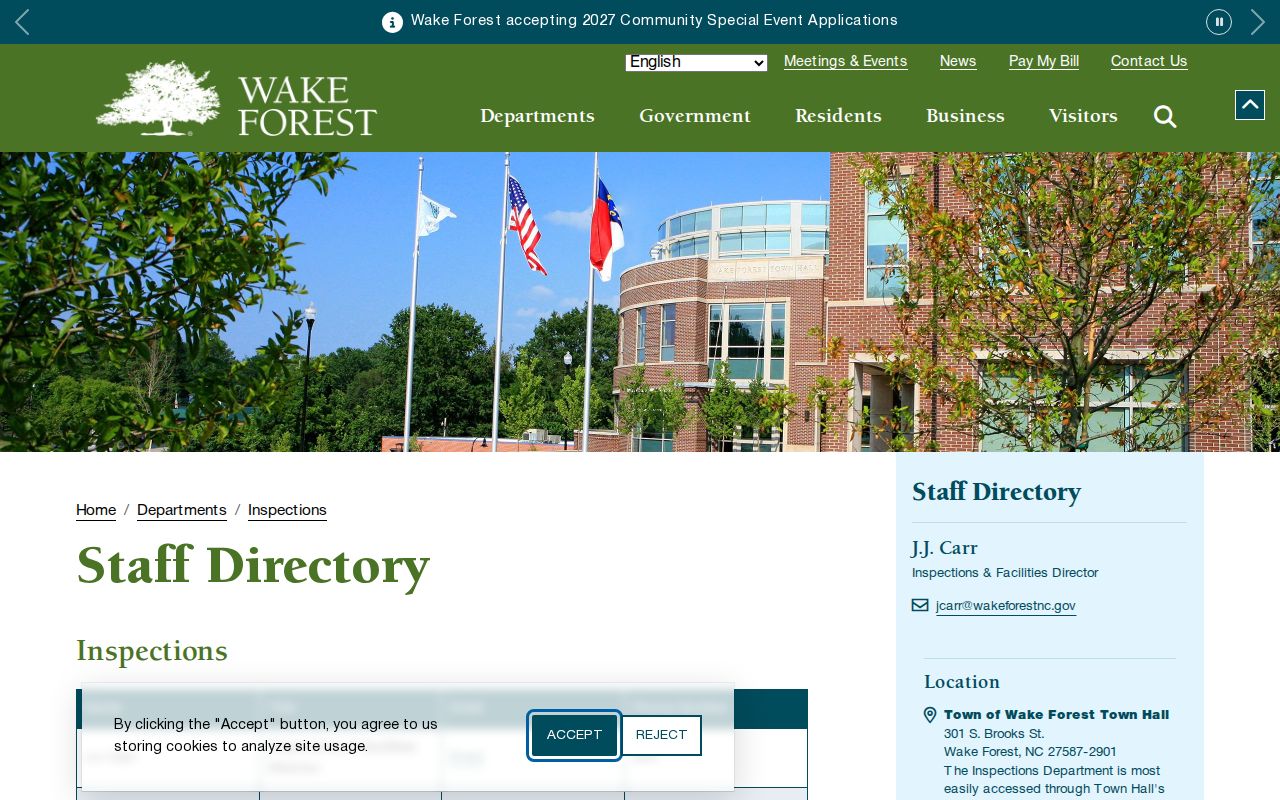
Its department-level layout makes role and contact details easy to read, but it does not offer a townwide name query or export. If a person is absent, call the department main line or Town Hall at 919-435-9400. The Town Clerk’s public-record channel is the next step for an existing roster, board list, or municipal record. No consolidated official state employee people directory was verified, so state agency rosters must be searched separately.
Note: A Town roster is a current contact source; it is not a history of everyone who once worked for Wake Forest.
Compare Wake Forest Staff Directories
The town’s browse-only structure contrasts with the Wake Forest High faculty and staff directory. The school tool accepts any of three optional fields. A broad keyword can find a role, while first and last name fields narrow a known person. At inspection, it displayed 158 constituents across 18 pages, nine results at a time. That count describes the live directory then, not a permanent staff total.
| School Directory Field | Required | Best Use |
|---|---|---|
| Keyword | No | Search a role term or other indexed text. |
| First Name | No | Narrow a known given name. |
| Last Name | No | Find a family name or combine with first name. |
A result entry may show the person’s name, role classification, school context, and available contact information. The inspected sample paired Gregory Ackles with “Teacher - Regular Classroom - PET.” The school address is 420 W. Stadium Drive and the main line is 919-554-8611.
The school search screen shows how keyword and name fields replace the town roster’s department browse.
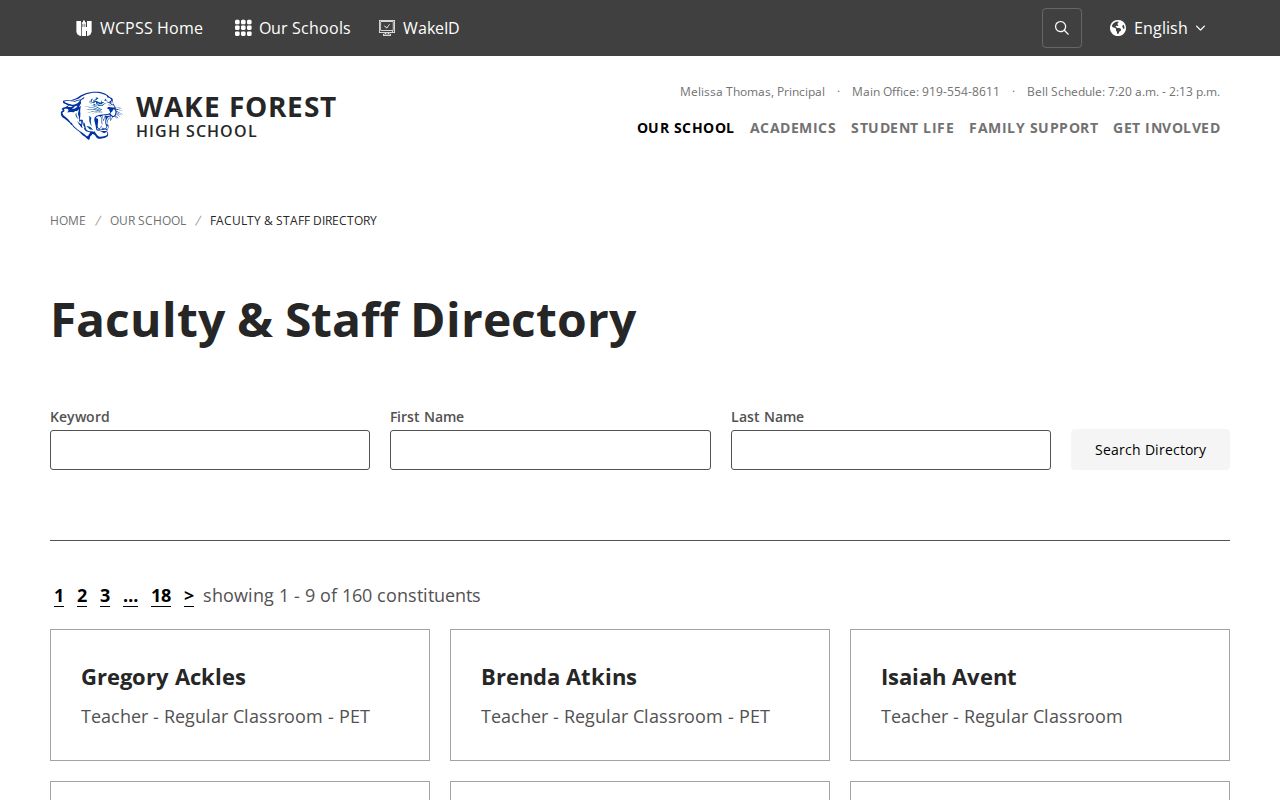
The result count and pagination are useful for browsing, but opening a current entry provides the strongest school contact detail.
Wake Forest Owner Directories
The Wake County Real Estate Search acts as a role directory for owners of record. Search a surname or business name, street address, REID, or PIN. An account can show owner and co-owner formatting, a mailing address, property or situs address, legal description, tax district, values, sale data, deed book and page, and links to maps or bills.
“Situs” means the parcel’s physical location. The mailing address is where tax notices go. They may differ, and neither proves that the owner lives on the land. A trust, business, heir, or care-of line also needs exact transcription. Use Wake County iMAPS to check boundaries and jurisdiction. A northern Wake Forest address may instead fall in Franklin County, where Franklin GIS and deed sources control.
The property roll is current, while online tax bills from 1994 forward can form a dated owner or billing trail. Follow the account’s book and page into the deed directory when the legal transfer matters.
Wake Forest Deed Name Directory
The Wake Register of Deeds records application and older Consolidated Real Property Index list people by instrument role. A grantor gives or transfers an interest; a grantee receives it. Search initials, prior surnames, spelling variants, trustee or entity names, broader dates, and a known book and page. Recorded document images are available from July 1785 forward, though series access can vary.
An index row is a locator, much like a catalog card. It may identify party, document type, date, and book/page, while the scanned instrument can add mailing addresses, entity capacity, legal description, preparer, return contact, parcel IDs, and prior-title context. Plain or certified copies come from the recorder. Earlier or access-limited material requires the office or archives.
Wake County’s separate Enslaved Persons Search held 2,156 indexed items across 144 pages when inspected. Its fields include All, Date, Book, Page, Grantor, Grantee, and Enslaved Person’s Name. Preserve the name and book/page, then read the instrument. Never assign a transaction party’s surname to a named enslaved person without evidence.
Wake Forest Public Role Directories
The public voter file can serve as a Wake Forest directory of registration roles, but it is not a resident list. NCSBE publishes weekly and historical files; filter the Wake County file by municipality_desc. The fields can include public name, address, status, birth year, party, precinct, and districts. Full dates of birth, exact identification numbers, submitted email, copied signatures, and protected addresses remain confidential.
The Secretary of State business search lists entities, status, registered agents, office addresses, and filing history. Search legal and trade-name variants. Then compare the separate assumed-name index and any regulated license. A registered agent is not automatically an owner, and an active filing is not a broad endorsement.
These people directories name someone because of a public role. The voter roll reflects election administration; the SOS index reflects an entity filing. Neither should be stretched into a claim about every resident or business relationship.
Wake Forest License Directories
North Carolina professions use board-specific official directories. Useful searches include the Medical Board, Board of Nursing, State Bar, contractor licensing board, Real Estate Commission, Cosmetology Board, educator verification, and ABC permit search. Each reports only its regulated facts, such as name, license type, status, expiration, firm, specialty, location, or public discipline where authorized.
- Medical license verification for physician status, place, specialty, and public actions.
- North Carolina State Bar directory for name, bar number, status, and contact information.
- Real estate license lookup for broker, firm, status, and license details.
- Contractor license search for licensee, qualifier, class, and status.
Compare exact names, dates, addresses, and status across the relevant board and SOS filing. Similar names require more than a single hit. Wake Forest does not publish a general city business-license person directory, and no authoritative open chamber member roster was verified.
Wake Forest Historical Directories
Olivia Raney Local History Library is Wake County’s main genealogy collection. Its catalog and DigitalNC contributions include yearbooks, catalogs, scrapbooks, and local objects. Confirmed Wake Forest College yearbooks are discrete: 1912; 1915 through 1918; 1921, 1922, 1925, 1928; 1931, 1933, 1937, 1938; 1940, 1941, 1944; 1946 through 1949; 1953; and 1976. These are not a continuous 1912-to-1976 run.
Catalog records marked “Consult Staff” are a clear access route. Ask for the call number or container, use limits, copy rules, and any name index. Request exact Polk or Hill volumes that include Forestville or Wake Forest, criss-cross sections arranged by address, phone books, newspaper microfilm, and obituary aids. No defensible continuous Wake Forest city or reverse-directory run was verified online.
- City directory
- A dated listing commonly arranged by name, often with address and occupation.
- Reverse directory
- A criss-cross listing arranged by street address or telephone number rather than surname.
- Yearbook
- An exact-year school or college roster with students, faculty, groups, and images.
- Catalog record
- A description of an item or collection, not proof that every name inside is indexed online.
For former classmates, pair an exact-year book with newspapers, census, cemetery, or estate evidence. Current authenticated alumni directories and open neighborhood or congregation rosters were not verified, so historical institutions are the sound fallback.
Note: Published year endpoints do not imply continuous holdings; request the exact Wake Forest volume and year before relying on coverage.
Trace Wake Forest Directory Names
Local names changed in ways that affect directory results. North Main Street was once Faculty Avenue. Forestville remained a separate identity until joining Wake Forest in 1988. The Glen Royall mill village joined in 1977, and older college records may describe Wake Forest College rather than the municipality. A historical query should cross a person’s name variants with both place names and the right date.
| 1805 | Forest District was already in use. |
|---|---|
| 1834 | The Baptist institute opened, starting the long college directory trail. |
| 1874 | The depot moved from Forestville, reshaping the local commercial center. |
| 1956 | Wake Forest College moved to Winston-Salem. |
| 1977 | The Glen Royall mill village joined the town. |
| 1988 | Forestville joined Wake Forest after its separate history. |
Search Faculty Avenue beside North Main and Forestville beside Wake Forest. For a northern modern address, verify Wake or Franklin County before choosing tax, deed, voter, or archive sources. Postal city, town limit, and county custody are not the same boundary.
Wake Forest Memory Directories
The Wake Forest Historical Museum collections cover the college from 1834 to 1956, the town from 1800 to 2025, and the surrounding area. Photographs, letters, writings, recordings, artifacts, organizational files, past Wake Weekly material, and DuBois School records can identify students, faculty, mill families, residents, and community groups beyond a standard directory entry.
Wake Forest Cemetery at 400 N. White Street adds interment and plot leads through the town’s mapped service and cemetery office at 919-435-9570. The ArcGIS endpoint advertises a 2,000-record query cap, but its exact public fields should be checked before assuming that every grave is searchable. Pair a plot result with a death certificate, obituary, church or funeral record, inscription, or estate file.
The Wake Forest History Exchange ties reviewed community stories to place; submissions are normally reviewed within one to two business days. It can explain a site or family context, while the museum, cemetery keeper, library, and archives remain the custodians for source records.